Showing posts with label gecko. Show all posts

Sunday, May 12, 2013

Live Food Care: Part 1: Crickets

If you own a reptile, it is almost inevitable that you will deal with live food. Not always: if you have an herbivore or you feed frozen mice, then you are certainly in the clear. However, many reptiles out there are insectivores. I own three reptiles that require insects for their diet. Helix is ALL insects while the turtles also have pellets and greens. I could give some to Salinger for her protein source, but I prefer to use dry cat food instead (maybe I should also write a blog on tortoise protein nutrition options since there is a misconception that ALL tortoises are strictly herbivores). But for now, this post is on crickets. How to care for them and how to set them up.

First, you would need a cricket keeper. You can either purchase one from a store, like so:


This is the smaller one. There is also a larger keeper available.

Or, if you're like me and want to go do it yourself, you can also make one fairly simply. Buy a large tupperware/food storage container. Use an awl to cut small holes on the top for air flow. Wah-la!
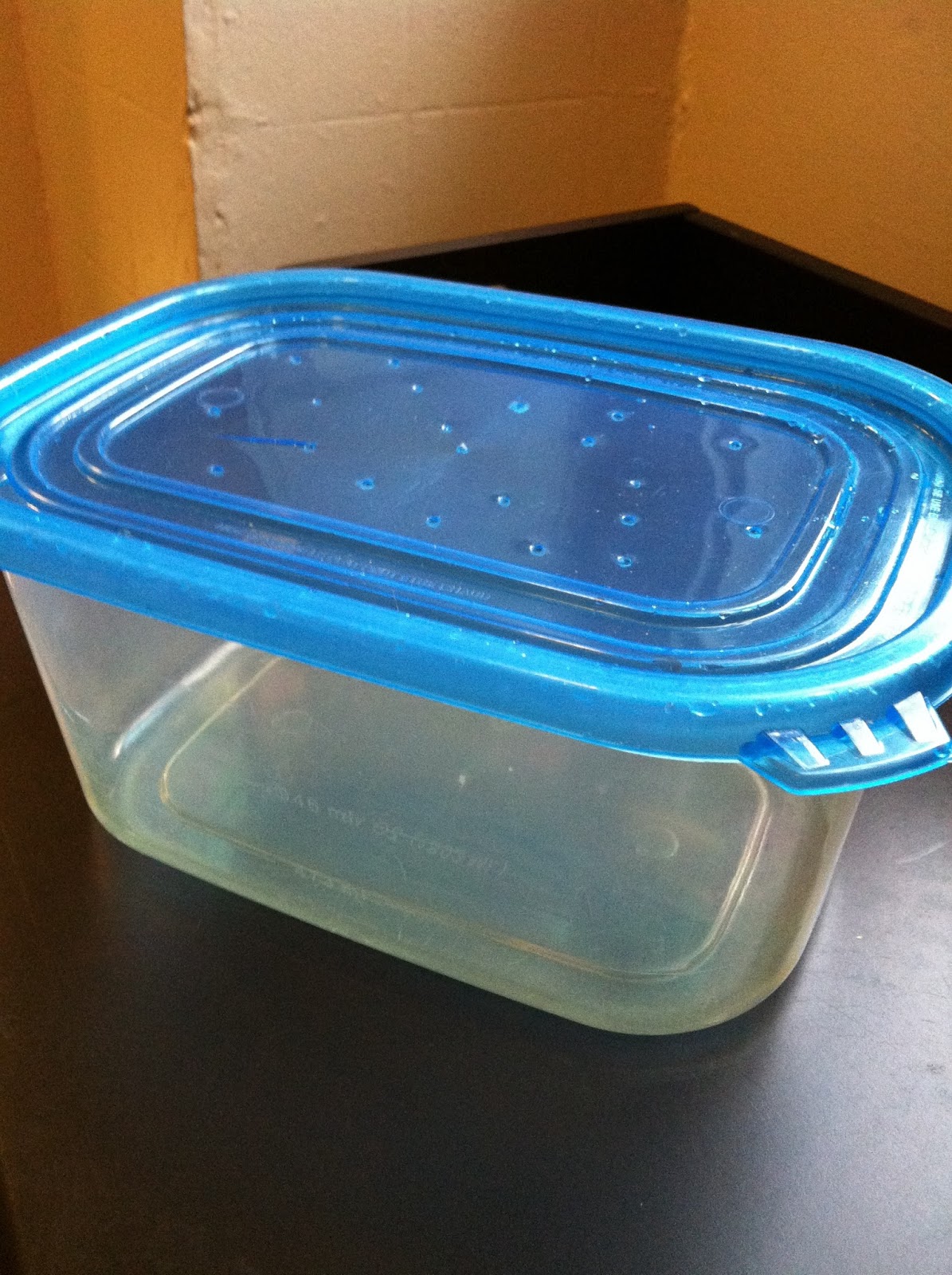
Next, purchase two small food dishes. There are some at the pet store for a dollar each. You will need these for food and "water."

For the food dish, use the cricket chow you can find at a pet store. For the water dish, I recommend soaking 2 (or more, depending on how many crickets you plan to keep) baby carrots for a couple of seconds under water. Then, chop them on into about 4-5 pieces. This is how I personally like to give them nutrients and water. There is a product called Cricket Quencher that many people use instead of the carrots. I find that more crickets drown in this than the carrots. It is a personal preference. You can certainly use the Quencher if that suits your needs better. So the two bowls should look like this:

The last thing you will need is egg carton. You can either ask the pet store to give you some (they often ask you) or you can save your own egg cartons and cut them into smaller pieces. I do both. I recommend buying crickets from the actually store, not the cricket to go containers. They often have a shorter shelf life. It is also cheaper to get crickets from the stock batch. We found out we have a better success rate of survival with Petsmart crickets over other pet stores. They take really good care of their crickets, and they already have them "gut-loaded" so you don't have to wait to feed your pet.

And then mix it all together!

1. Container 2. Dishes 3. Food 4. Water/Carrots 5. Egg carton 6. Crickets

Make sure to store them in a dry place. Temperatures should be around 75 to 85 degrees or so. I tend to tell people to buy only a week's worth supply at most. Crickets have a short life span. Feed them to your reptile using feeder tongs. Crickets make an excellent food source than other insects so it is worth it to take care of them so that they take care of your pet!

Sunday, April 28, 2013

About Carlie

Spencer and I decided to take on another foster gecko. She was surrendered already knowing she had a pre-existing condition, metabolic bone disease. I just didn't know how bad. First, she was surrendered as "Carl - 2 years old." We found out that Carl was really Carlie just a day or two later. When I first met Carlie, she couldn't even see. The shed of her skin was stuck to her entire face and parts of her legs. I immediately soaked her in warm water for a long time. After the next couple of days, we are able to peel of the skin on her face so she could see. We then slowly peeled off the rest. What was also blatantly obvious is that her spine was crooked and humpback.

Needless to say, she was in worse shape than the others, but Spencer and I were up for the challenge. We brought her to Dr. Mertz at the New England Wildlife Center Odd Pet Vet. He told us that her deformity was pretty much for life (also her minor leg paralysis), but we could help her with shedding. We started her on 0.1 cc of antibiotics per day. She was close to losing her tail and very underweight. We did our best to fatten her up, socialize her, and help her with shedding. After a couple of weeks, she started to prolapse a little under the stress of holding her. She was always able to kick it back in fairly quickly. However, one Sunday night, she prolapsed so much that her lower intestines were out. We put her in a shallow pool of water with a paper towel in it to keep her moist. Unfortunately, she needed serious repair or she would die. We contacted our vet, and he told us that she lost muscle control in her back end due to the calcium deficiency. She will continue to do this most of, if not, her entire life. That's when I realized she would not be adoptable. We made the difficult decision to rush her to my work, Animal Rescue League of Boston, to put her down. Spencer and I miss her so much. She had a wonderful temperament. She was calcium deficient during infancy and childhood which resulted to her demise. I couldn't help wondering what other reptiles like her are suffering the same things due to poor nutrition. When we came back home, I spent a long time watching Helix, our own gecko. I felt so fortunate that he was a healthy boy. Not every gecko is so lucky...

In memory of Carlie who is no longer with us. April 22, 2013

Sunday, February 17, 2013

Picture credit on the right belongs to Elizabeth Dobrska

And look what happened yesterday: Olive was adopted by a wonderful family! This is pictures of me, her, and the father of a 13 year old son who will be taking wonderful care of Olive from now on. It is a surprise gift for the reptile enthusiast! It was a perfect match from the geck-ko! haha. This is my first successful foster "child" to make it to adoption and what a wonderful feeling. We will miss our little gecko girl, but I couldn't be more happy for her. She finally has her forever home.

This is our foster gecko Olive when she first came into our care. She certainly needed our help!

Monday, February 11, 2013